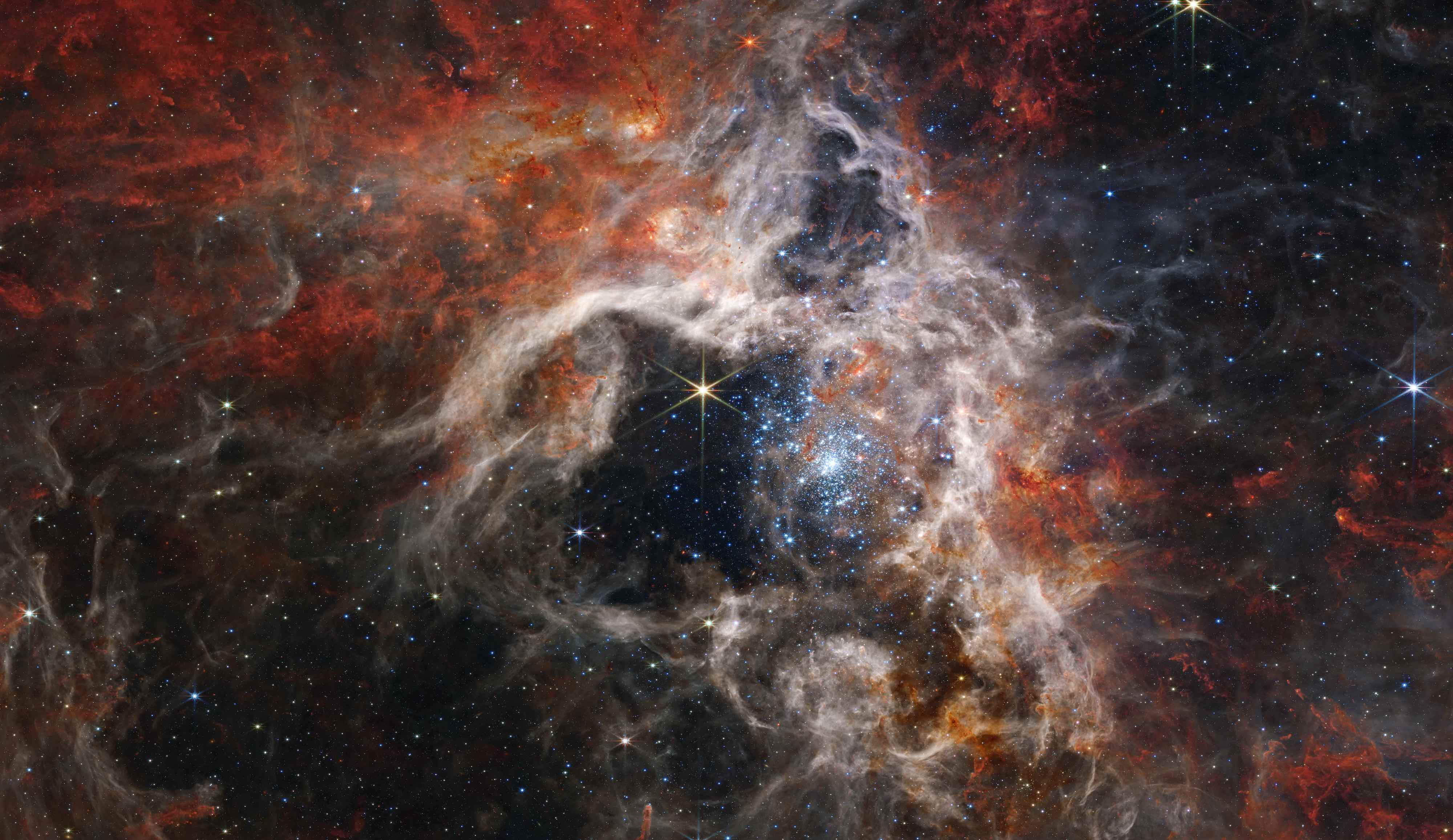
Deep Sky is an IMAX original documentary that shows the ‘how’ and ‘why’ behind the James Webb Space Telescope (JWST). Just building the telescope took years to complete and came with many obstacles to overcome. But not long after launch, the reward in imagery would prove the efforts worth ten-fold.
Directed by Nathaniel Kahn and narrated by Michelle Williams, Deep Sky takes a shot at answering the age-old question, “Are we alone?” The discovery of light, planets, and galaxies would lead the experts shown in this documentary to answer with an emphatic “No”. As production chronicles the construction, launch, and mission of the JWST, its exclusive presentation in IMAX theaters serves as a proper environment to voyage deep into the universe. “Ever since I was a kid I was fascinated by the stars,” says the Oscar-nominated filmmaker. And if you’re a fan of the mysteries of the universe and/or the science behind it, then you’ll thoroughly enjoy the film.
The film begins at the National Aeronautics and Space Administration’s (NASA) Goddard Space Flight Center five years prior to the telescope’s launch. The biggest hurdle they face is finding a way to fold up this gigantic mirror and protect it from the sun (while also keeping it cool). The diameter of Webb’s primary mirror is 6.5 meters (21.3 feet) and comprises 18 individual segments coated with a thin layer of gold. So imagine being tasked with not only having to fit this inside of a rocket but because the JWST is an infrared telescope, it must be kept below -370 degrees Fahrenheit.

Starting in Los Angeles, CA, the 6,000-mile journey through the Panama Canal to the launchpad in French Guiana had cost $10 billion. Once in orbit, the telescope will have to fly to L2 (four times farther than the moon). On the way, over 300 deployments must go perfectly for it to work. They’re called ‘Single Point Failures’, meaning if one thing goes wrong, the mission will fail. But audiences won’t be left waiting too long until they’re blown away by what the JWST has in store in IMAX quality.
Outside of the science and engineering behind the mission, there was a very noticeable push for the Big Bang theory. Being force-fed this for 40 minutes seemed a bit unnecessary and extraneous but it doesn’t ruin the experience. Hearing Dr. Amber Straughn, an astrophysicist at NASA, utter a biblical passage, “I once was blind but now I see,” was a welcomed break from the consistent push of, “We’re all made of stars” as if auditioning for Disney’s WISH.
The film features firsthand accounts and interviews with experts such as Amber Straughn (NASA), Jane Rigby (NASA), Gregory L. Robinson (NASA), Amy Lo (Northrop Grumman), Scott Willoughby (Northrop Grumman), and a host of others.
Deep Sky gets a 7.5 out of 10. For it to be so short, it drags if you aren’t really into space exploration and talk of galaxies. As far as an IMAX experience, there’s no better option than this. These first images are incredible and the story behind them, as narrated by Michelle Williams, will explain how and why these findings are such a big deal.
Get tickets at an IMAX location near you.
-Jon Jones
Photos: Courtesy of NASA
*Cover photo caption: Featured in the IMAX® documentary DEEP SKY, this mosaic image stretches 340 light-years across. JWST’s Near-Infrared Camera (NIRCam) displays the Tarantula Nebula star-forming region in a new light, including tens of thousands of never-before-seen young stars that were previously shrouded in cosmic dust.