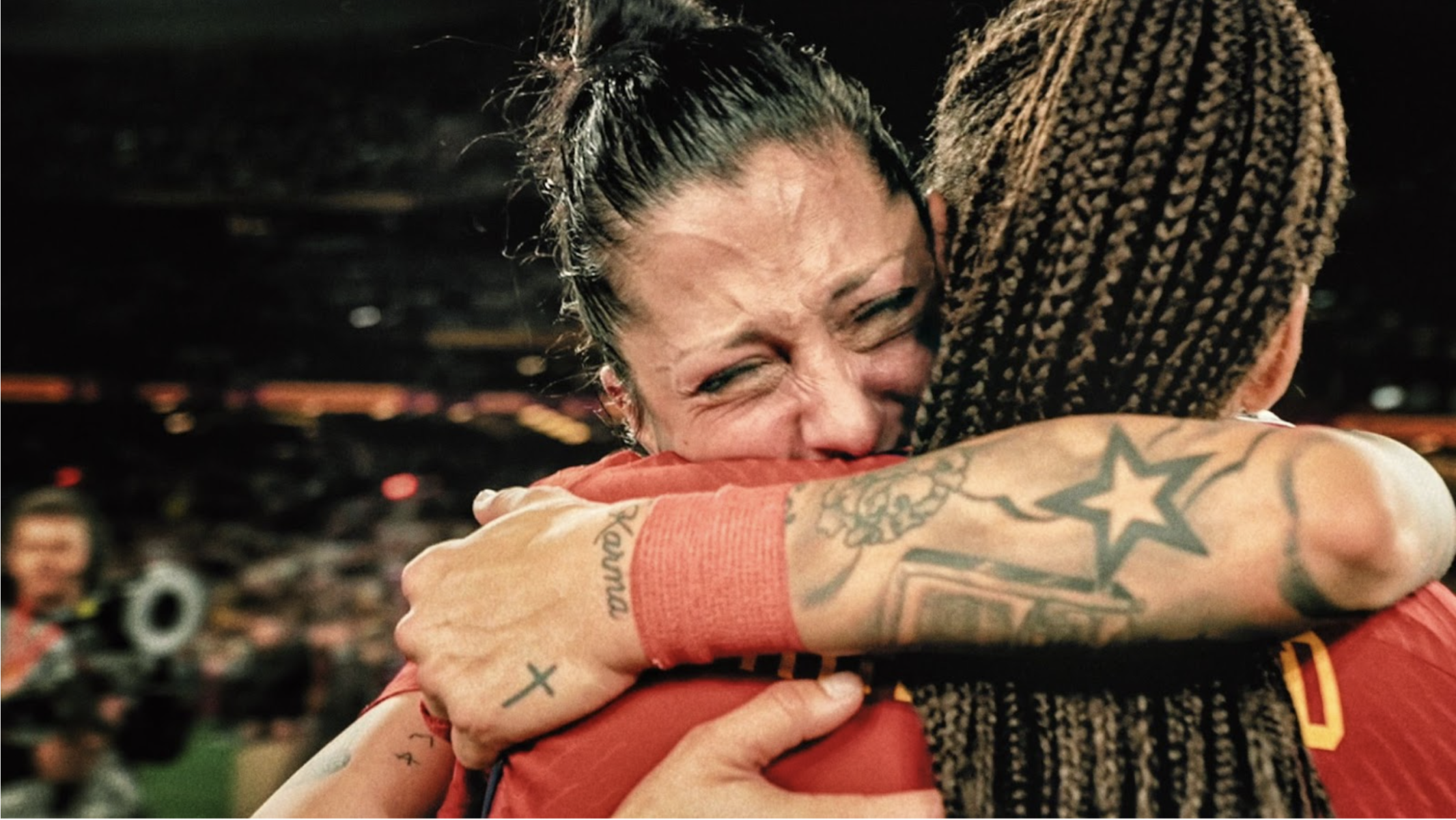
As a longtime supporter and avid fan of women’s football, I was elated to hear of a documentary in the works covering a women’s national team. When I got word it would be Spain, I knew exactly what to prepare for.
Luis Rubiales, the president of the Spanish Football Federation, kissed Jenni Hermoso on the lips in front of the entire world. It was a dark moment that overshadowed the most momentous occasion in a footballer’s life: winning a World Cup. Most players could only dream of reaching the famed tournament but in the case of “La Roja” (Spain’s nickname for the women’s team), they entered as underdogs and left victorious.
The documentary features firsthand accounts from players like Jenni Hermoso, Irene Paredes, Aitana Bonmatí, Ivana Andrés, Alexia Putellas, Laia Codina, Olga Carmona, Teresa Abelleira, Lola Gallardo, and Sandra Paños. Former player Vero Boquete lent her perspective on the matter as well as journalists such as Andrea Peláez and Alejandro Requeijo.

Rubiales had a reputation for catering to the men’s team and “dealing” with the women’s. The drama first started after their exit from the European Championship in 2022. The players sent messages to the president stating that change was needed and there was unrest in the locker room. Rubiales saw their request as a challenge to his authority. Petty, insecure actions by Rubiales, marked the beginning of the beef between the women’s players and the federation. Their reasoning behind the desired change was simple: equitable treatment. Beyond the pay, all the women’s team was looking for was better flight schedules and proper places to train, simple requests like that. It’s unfortunate to mention that the men’s team was catered to hand and foot and flew by charter. The women didn’t even ask for that, just improved travel schedules. Their requests were met with dismissal and the ladies had reached their wits end.
15 players signed a letter and stated that they would no longer play for the national team. Out of those 15 players, eight returned after an agreement to work on improvements was made. Only seven held strong and didn’t return. Having to field a squad for the biggest tournament in the world, Vilda was forced to call up a large swath of fresh blood to try and do the impossible: win a World Cup with a disjointed team.
Once the Women’s World Cup began, things weren’t so bad for La Roja in the group phase. Things were looking up after steamrolling their first two opponents, Costa Rica and Zambia. But when the team faced former world champions in Japan in their last group match, they were destroyed 4-0. In the documentary, the ladies were very vocal about how unqualified Jorge Vilda was for the job. One player recounts a moment during that match when she asked for instruction from the gaffer but he couldn’t provide any. The ladies were left on their own in a blistering defeat with a coach who couldn’t coach, let alone adjust on the fly.
The players tell the whole story about how Vilda even came into the job. His dad was Rubiales’ right-hand man, and through connections, was not only offered the initial contract but then signed an extended contract years later. It was a complete conflict of interest since the hiring and firing of coaches was up to the sporting director, which was the title he held while coaching. Vilda, who came in without any coaching experience whatsoever, was tasked with leading a national team with players who felt like they were there to be checked off of a list. A completed task so to speak.
It cannot be understated how bad the situation was for the women’s national team. Jenni Hermoso faced monumental harassment in an attempt to cover up what happened to her. Personnel within the federation were constantly watching the players, listening to conversations on the flight back to Spain (after the incident occurred), and we learn in the film that one player even had their phone tapped. The ladies supported their teammate as much as they could and since it was seen all over the world, it was impossible to travel anywhere without being reminded of what happened. During a gathering amongst friends, Hermoso shares snacks and stories with two of her teammates recounting that time and how it almost broke her. There were death threats and harassment, but what hurt her most was the constant lying from Rubiales. A man with that level of power was simply framing the narrative however he wanted and it often made the ladies look like they set him up or that Jenni requested the kiss.
#SeAcabo turned into a movement that paralleled USA’s “#MeToo”. In Spain, it rocked the country from top to bottom, with masses demanding the resignation of the Spanish president. It was a globally trending topic online and both men and women in football were taking notice as well. Entire teams were wearing shirts with the hashtag, some wore bracelets, and others expressed their support during goal celebrations. It was a beautiful moment for women and the sport as the game has risen to heights unseen.

It was impressive to be able to gather that many willing participants to speak up in detail about the matter since it’s so fresh. Remember, the incident just happened last summer in 2023. We’re in November of 2024 and frankly, the dust has just started to settle on the matter. Learning about how the original crop of players who stood up to the federation supported the latest group of defectors was beautiful and showed how women supporting women will always result in a win for women.
It’s All Over: The Kiss That Changed Spanish Football gets an 8 out of 10. Filmed in Spanish with English subtitles and dubbing, the documentary gives unprecedented access to the people on the frontlines of the movement and the dissension. Some had to sacrifice very little while others had to sacrifice everything. In this beaut of a film by Netflix, we learn in detail how an arrogant, self-absorbed president who showed bias and nepotism was brought to task by a group of relentlessly courageous women.
It’s All Over: The Kiss That Changed Spanish Football is available now on Netflix.
-Jon Jones
Photos: Courtesy of Netflix
Genre: Sports Documentary
Rating: TV-MA
Runtime: 95 minutes
Trailer: Watch
U.S. Release Date: November 1, 2024