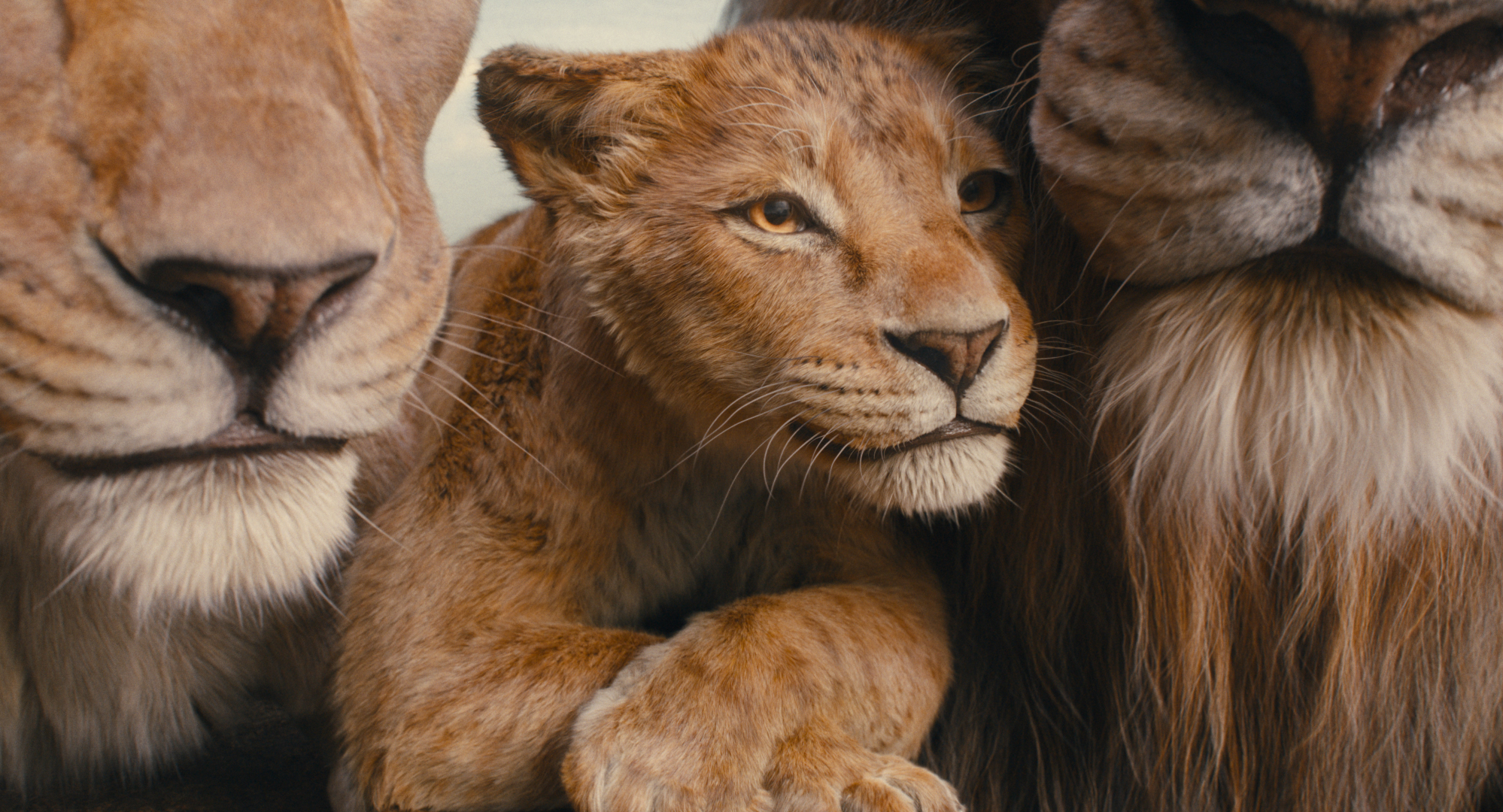
Mufasa: The Lion King explores the unlikely rise of the legendary king of Pride Rock. Directed by Barry Jenkins, the film enlists popular raconteur Rafiki to tell the tale of Mufasa’s rise to kingship.
Simba (Donald Glover) and Nala (Beyoncé) are set to journey together far away, leaving their young daughter Kiara (Blue Ivy Carter) behind. In the care of Timon and Pumbaa, Kiara is unable to sit still as a massive storm looms overhead. But when Rafiki (John Kani) arrives, he brings a sense of calm and assurance, not to mention an extensive recollection of her grandfather’s story. Told through a hefty collection of flashbacks, Mufasa’s story takes audiences from his time as an orphaned lion cub to a destiny fulfilled.

We learn a few things in this film that feels like a Mufasa biopic. First, he might’ve been born into royalty but was soon removed from privilege. His beginning was one of humble roots and learned as he went along. He was kind, compassionate, and selfless, never viewing anyone as an enemy and always open to working together. One day, a great flood separated the young cub from his family and washed him downstream. It’s here that his origin story begins and his destiny gets set into motion.
The main question behind the characters in Disney’s The Lion King was, “How did Mufasa and Scar become brothers?” A few decades later we finally have our answer. Born Taka (Kelvin Harrison Jr.), he and Mufasa meet purely out of happenstance and bond rather quickly. Having a shared desire for a brother, the two were inseparable, even though Taka’s father, Obasi (Lennie James), did not approve of outsiders. Having to beat Taka in competition to stay, Mufasa was cast to be with Eshe (Thandiwe Newton) and the lionesses, as Obasi was reluctant to keep him. The sentence would work in Mufasa’s favor, teaching him how to hunt and become one with the land. He could sense herds from as far as a day’s distance and even which animals they were. Everything he learned would prove helpful on his journey.
The visuals were simply incredible, weaving a blend of live-action and photoreal computer-generated imagery. Together, audiences are in for an ethereal treat, absorbing a gorgeous tapestry boasting Africa’s diverse landscape and its cultural and topographical richness. The film takes viewers on a visual journey, showcasing a range of environments from sunny days to snowy nights, providing a unique and refreshing perspective.

The songs were nice but also meant for a younger generation with a fresh set of eyes and ears. It was clear Lin Manuel Miranda was involved with the project purely from the lyrics and presentation. You won’t hear anything like Elton John’s now legendary theme “Circle of Life” from the 1994 original, but there are a few tracks that should bode well. “I Always Wanted a Brother” comes to mind as it’s one of the first songs introduced to audiences. “We Go Together” was another memorable track, but “Bye Bye” stood out the most. It had a catchy beat and a unique rhythm to it. Taka had his moment in the sun with “Brother Betrayed”, which didn’t quite hit the same as the fabled “Be Prepared” but again, a new angle for a new generation is understandable.
Mufasa: The Lion King gets an 8.5 out of 10. This is an absolute must-see in IMAX wherever available. While completely unnecessary, the film was rather enjoyable and the live-action was incredible. It felt disjointed at times since there were so many flashbacks instead of a streamlined story but it was more of an annoyance than a fault. One detail that might have been missed by some viewers became apparent to me early on. While lions have their own social structure, there’s an inherent understanding of boundaries and respect within the pride. Barry Jenkins cleverly weaves in a parallel to real-world issues by depicting the white lions as a disruptive force, disregarding boundaries, and ruthlessly killing and displacing the established pride. This subtle commentary, cleverly woven into the narrative, adds a layer of depth that will resonate with adult viewers. It’s a testament to Jenkins’s skill as a filmmaker – a reminder that even in a children’s film, there’s always something for the adults to appreciate.
Mufasa: The Lion King premieres in theaters on Dec. 20.
-Jon Jones
Photos: Courtesy of Walt Disney Pictures
Genre: Animation
Rating: PG
Runtime: 1hr 58 mins.
Trailer: Watch
U.S. Release Date: Dec. 20, 2024.