There has never been a better time to take a magnifying lens to the workforce than now. With significant job losses and rising inflation impacting the lives of many Americans, those who remain in the workforce are struggling to hold on. History has shown that in times of desperation, companies traditionally rein in their spending. Depending on how greedy, er… ambitious a CEO may become, orders from the top may result in lower management manipulating or even abusing rules or employees. Situations like these are why labor unions were created.
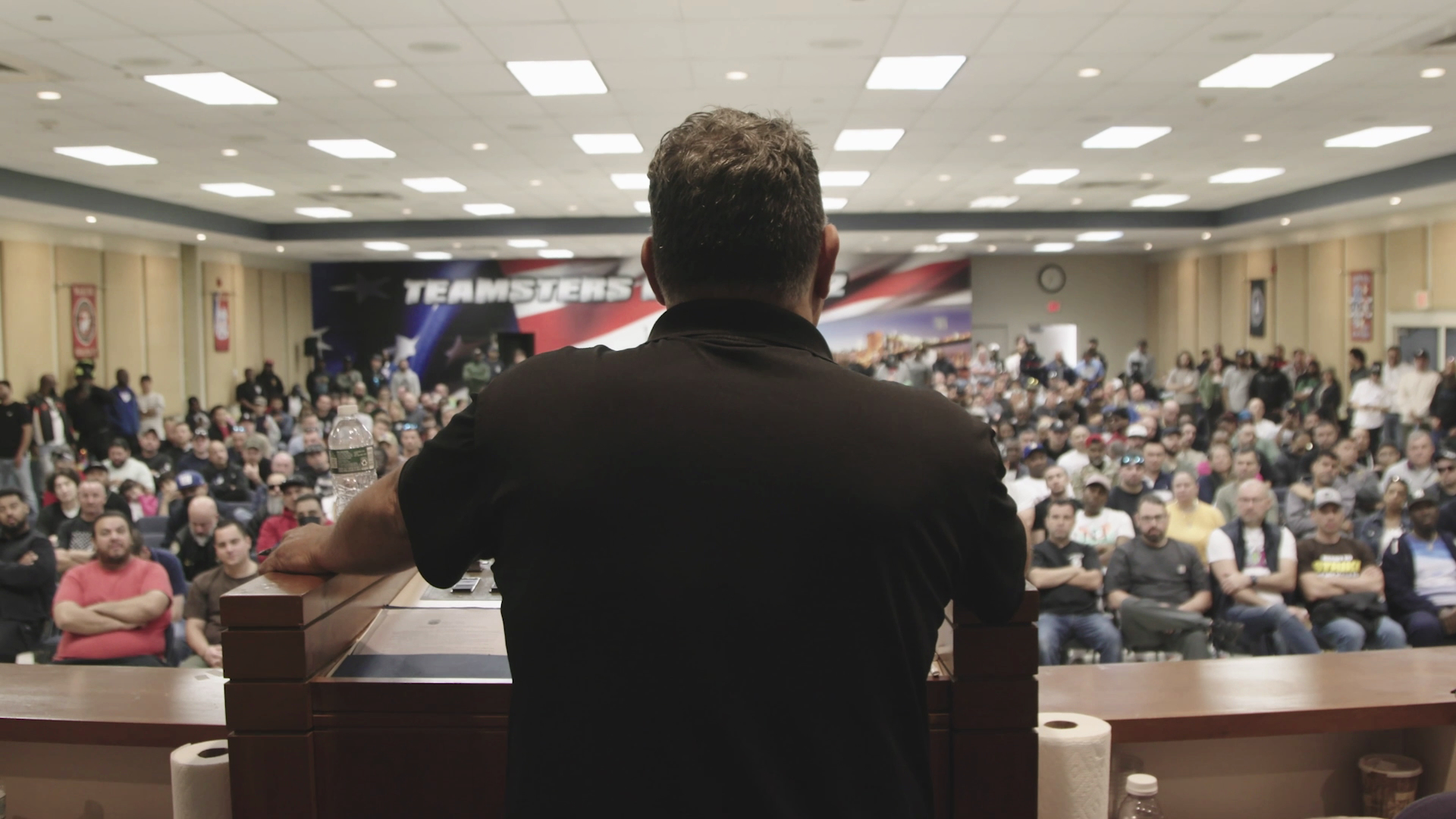
Director Yael Bridge, an aficionado of organized labor known for films such as Saving Capitalism and When We Fight, follows a handful of UPS Teamsters in Who Moves America as they decide whether to accept a new contract or go on strike. With their current contract set to expire, Bridge documents their contract demands (safety, better pay, humane hours, etc.) and their current conditions under their present contract (signed in 2018).
Reflecting on the early ’80s (I’m probably dating myself here), there were often discussions about unions. As a child, I didn’t understand what the commotion was about, but I usually heard the term in correlation with factory workers or “blue-collar” jobs. One thing that I remember clearly was that the very word “union” often came before the name Jimmy Hoffa. At present, that name usually triggers two very strong opinions: he was a corrupt man with mob ties who mysteriously disappeared, or he was the crown jewel of the International Brotherhood of Teamsters (IBT) who helped propel the union into the massive force it is today. How massive a force are they today? The IBT has roughly 1.2 million members today, and a third of them, 340,000, are UPS employees, making the carrier the single largest employer of Teamsters in the United States.

It’s not hard to see how a presidential union seat would come with great power and influence, and lest we forget the responsibility for its members, who number in the millions. Knowing this, it makes a statement when the IBT supports a movement or backs a party. Having backed the Democratic Party since 1996, union leadership declined to put its support behind Donald Trump or Kamala Harris. But that didn’t stop Sean M. O’Brien, Teamsters General President, from being a vocal Trump supporter. An interview last summer in The Hollywood Reporter detailed O’Brien’s relationship with Donald Trump, his attendance at the Republican National Convention, and his involvement with a political party that’s historically anti-union.
Yael Bridge, along with producers Jeremy Flood, Yoni Golijov, and Mars Verrone, follows employees from California to the deep South and the Northeast to get a better understanding of what’s at stake. Benefits and safety aren’t the only battles facing these Teamsters. When examined more closely, several invisible barriers divide the members, including age, employment designation, and varying self-interests.
After signing a contract that, by all employee accounts, was abhorrent in 2018, UPS Teamsters are looking to set things right with a new contract in 2023. Justin, a UPS driver in California, enjoys his job and the benefits that come with it: union membership, health insurance, and most importantly, pensions. Driving for UPS is widely considered a coveted position, especially when compared to FedEx and Amazon, as Justin stated, “It could be worse.”
Audiences will hear references to the ’97 protest repeatedly in the film, as seasoned members use the victory as motivation for newcomers to the IBT. In 1997, a successful 15-day nationwide strike involving 185,000 workers protested excessive part-time labor and poor pensions. Led by then Teamsters President Ron Carey, the strike resulted in UPS losing millions of dollars and was widely supported by the general public. The few Teamsters who remained after all these years spoke with reverence about the strike. Some called it the Teamsters’ greatest victory. But that victory was 29 years ago, meaning the few employees left were close to retirement, and convincing two generations of youth (who may never see social security) to sacrifice their already low wages to strike was not going to come easily.

In the film, we learn that 60% of UPS Teamsters are part-timers making $16/hr. Most of them work as pre-loaders and package handlers. Full-time employees are truck drivers who start at $42/hr. Views varied widely, with the harshest critics coming from the Northeast. While the rest of the country carried itself with a certain calm and steadiness, New York/New Jersey proved that they continue to exist in a vacuum. In New York, one employee referred to UPS as “a white-collar crime syndicate.” When the company eventually came to the table with an offer, the employees in New Jersey were fervent about voting “no.”
There was one area that every region of the country could agree on, and that was the scheduling that saw some “part-time” workers seeing 60+ hours in a week. Not only that, but both pre-loaders and truck drivers complained of gruesome working conditions, with one even resulting in death (the story of Esteban Chavez).
Who Moves America isn’t just a documentary; it’s an educational tool. It serves as a vital resource for understanding the symbiotic relationship between corporations and unions. This film sheds light on the crucial role unions play in shaping the workplace, highlighting that despite their differences, the two are interdependent, each relying on the other for mutual success and growth.
Who Moves America gets a 9 out of 10. Overall, the film is good, but for the younger generation (ages 18-25), this is a must-see. Neither UPS nor FedEx responded to my request for comment. The film made its world premiere tonight at the True/False Film Festival in Columbia, Missouri.
SCHEDULE:
Friday, March 6, at 6:45 PM –The Picturehouse
Saturday, March 7, at 9:00 AM – Missouri Theatre
Sunday, March 8, at 8:15 PM – The Blue Note
-Jon Jones
Category: Documentary
Country: USA
Director: Yael Bridge
Runtime: 1 hr 27 mins
Trailer: N/A
U.S. Release Date: March 6, 2026