
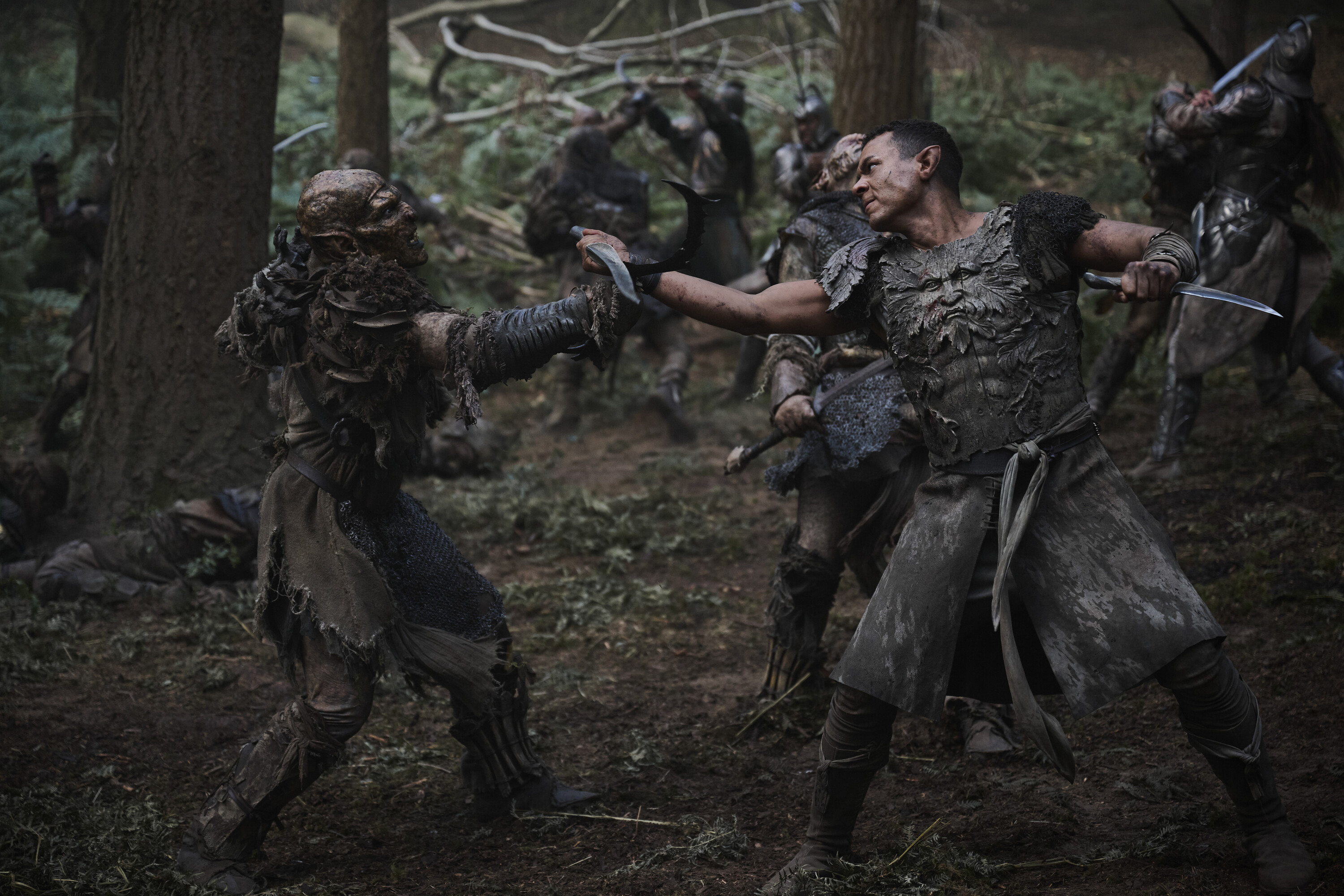
Nazgúls & wizards & fell beasts, oh my! Season 3 of The Lord of the Rings: The Rings of Power kicked off yesterday with the first four episodes. Episodes 5-6 will be available on Nov. 18, and the final two episodes will air on Nov. 25. Taking place five years later, war has spread across Middle-earth as Sauron relentlessly pursues one ring to rule them all.
This season has a good crop of excitement with little downtime. You could argue there’s too much character development, but that depends on who you ask. Still, overall, it’s an exciting season that’s reminiscent of what Peter Jackson gave us in Lord of the Rings and The Hobbit.

Announcements were made before the season began that sent purists into a frenzy, one of which dealt with the Balrog. In Tolkien’s writings, Balrogs are terrifying, demonic spirits of fire and shadow that do not speak or hold casual conversations. When faced by Gandalf on the Bridge of Khazad-dûm, the Balrog remains completely silent. Author J.R.R. Tolkien explicitly objected in his notes (as far back as 1958) to any depiction of a Balrog that talked, laughed, or sneered. Many Tolkien fans immediately rejected the decision.
Fans have also shared disgust over the humanization of orcs, which contradicts Tolkien’s description. Because if they’re supposed to be “irredeemable” and “demonic”, showing family units and emotions could cloud perspective. Are they misunderstood villains? Is there one who’s redeemable that could change the tide of the whole race? Are we mirroring Glenda the Good Witch with Ora the Good Orc? This is an area where I’d say creative license could be massaged. There isn’t a huge change, and actually, having never seen an orc with a storyline, series creators Patrick McKay and John D. Payne swung for the fences in the imagination department.

This season also takes fans down the backstory of the Nazgnagôl (Nazgúl). Names like “Lossoth” and “Haradrim” might not mean anything to you, but for the Tolkien-loving purist, it proves that McKay and Payne were mindful of the canonical writing. We never see them, which leads me to believe the show’s creators left the mention as a gift (Easter egg) for the purists.
If you take a step back and analyze Sauron’s reasoning for the rings of power, it might rattle your brain a bit. Like trying to explain Common Core Math to a Gen X-er, his seven rings for dwarves to counter the three made by elves for elves, then making nine for men before making one “ultimate” ring for himself, might not make sense. The same way critics argued the Eagles could’ve saved Frodo the trip to Mordor on foot, Sauron could’ve found a better way to corrupt the populace of Middle-earth.
For fans who haven’t read the books but followed the films, this season makes sense of what you saw on the big screen. Gandalf (Daniel Weyman) has a Moses and the Burning Bush moment, which further fuels speculation that Tolkien’s writings mirror biblical significance. The series takes a closer look at his purpose as a wizard and how he should proceed with what’s taking shape across Middle-earth. We get a formal introduction to the fell beast, who we’ve only seen mounted by Ring-wraiths in The Lord of the Rings. There’s not a steep learning curve to overcome, but more like a slight incline. The great thing about this series is you’re constantly incentivized to learn. Some episodes are more dialogue-heavy than others, but at least the info is helpful in solving a three-season-long puzzle.

I didn’t particularly care for how this season was marketed. Everywhere I looked, an Instagram Reel, Facebook video, or video on X would tout “War is coming!” And in fact, there was more traveling, strategizing, and dialogue than actual battles (and a lot of chatter from Sauron). We’ve also come to a point where the likability of Galadriel (Morfydd Clark) has to be questioned. I feel like her arc is still taking shape, but I’m more than ready for her to be wise and perceptive. The entitlement and the “only I can do this” attitude remind me of Clarke from The 100, and Cate from Monarch: Legacy of Monsters. All three are hardened women who carry a degree of survivor’s guilt, a martyr complex, and make brash decisions. How many times do you have to be humbled on a show?
Everything else was amazing. The developing drama amongst the dwarves takes an interesting turn. There’s some good writing to point out surrounding King Durin IV (Owain Arthur), Disa (Sophia Nomvete), and the characters in their proximity. The storyline that follows Marnûkh was a great idea. Anytime he was present, a situation would make you question his intentions and hold you in suspense. A really unique moment was shared when Marnûkh made a lament for a fallen comrade that I felt was character-defining. There wasn’t too much time spent on the Dark Wizard (Ciarán Hinds), which leads me to believe he’ll make a shock impact in the final episode (or else he’ll be an unfinished character in a very Game of Thrones-like manner).
Lord of the Rings: The Rings of Power Season 3 gets a 9 out of 10. This is easily one of the best television shows right now. The storytelling, world-building, cinematography, and sheer scale are on another level. It’s everything great television should be.
The first four episodes of The Rings of Power Season 3 are streaming now on Prime Video.
-Jon Jones
Photos: Prime Video
Genre: Adventure/Fantasy
Rating: TV-14
Runtime: 8 Episodes | 60 mins.
Trailer: Watch
U.S. Release Date: Episodes 1-4: November 11, 2026
Episodes 5-6: November 18
Episodes 7-8: November 25